

How to Coordinate Wedding Party Attire
Table of Contents
- Step 1: Define Your Wedding Party Color Palette
- Step 2: How to Mix and Match Bridesmaid Dresses Without Losing Cohesion
- Step 3: Groomsmen Suit Coordination Tips for a Polished Look
- Step 4: Wedding Attire Etiquette for Bridal Parties
- Step 5: Manage Body Inclusivity and Fit Across Your Party
- Step 6: Budget-Conscious Coordination Strategies
- Step 7: Communication and Coordination Timeline
- Frequently Asked Questions
Last Updated: September 27, 2026
Step 1: Define Your Wedding Party Color Palette
To coordinate wedding party attire effectively, your color palette is the foundation for everything that follows. It's the visual thread that ties your entire bridal party together, whether everyone wears identical dresses or each groomsman selects from a curated range. According to David's Bridal's 2026 wedding color trend report, pastels, warm neutrals, dusty rose, and earthy tones dominate this year's formal celebrations, but the real shift is toward intentional color storytelling rather than rigid uniformity.
Start by choosing 2-3 primary colors that reflect your wedding aesthetic and personal style. These become your anchors. Then add 1-2 accent tones that create depth without chaos. This layered approach gives your bridal party flexibility while maintaining visual cohesion.
Choose Your Primary Colors
Your primary colors should complement your venue, season, and overall wedding theme. Navy, charcoal, and black remain classic choices for groomsmen suits; for bridesmaids, consider jewel tones, soft pastels, or warm neutrals that work across different skin tones and lighting conditions.
Test your color choices at your venue during different times of day. A dusty rose that looks stunning indoors might wash out in bright outdoor sunlight. This prevents costly mistakes.
Add Accent Tones and Shade Variation
Shade variation is where modern wedding party coordination differs from outdated approaches. Rather than forcing everyone into identical colors, industry trend analysis from Instagram shows that 2026 celebrations embrace mixed tones within the same color family. Think navy, slate, and charcoal groomsmen suits paired with complementary pocket squares and ties in coordinating jewel tones.
For bridesmaids, you might have one shade of blush, one of mauve, and one of dusty rose, all reading as a cohesive color story. Visual harmony comes from the color palette itself, not identical silhouettes.
Introduce accent tones through accessories: metallic jewelry, contrasting pocket squares, or coordinating bouquet ribbons. These high-impact details create dimension without overwhelming your color scheme. A bronze or gold accent works across warm and cool palettes, while silver leans toward cooler tones.
Step 2: How to Mix and Match Bridesmaid Dresses Without Losing Cohesion
Mixing and matching bridesmaid dresses is no longer a compromise, it's a strategic design choice. Research from CHRIE's hospitality event management study emphasizes that coordinating complex groups requires clear communication and structured planning. The same principle applies to bridal parties: when you establish clear guidelines, mix-and-match approaches feel intentional rather than chaotic.
The most effective strategy is to fix one element (color) and vary another (silhouette or fabric texture). This creates visual harmony while allowing your bridesmaids to feel confident in styles that flatter their individual body types.
Matching Color Story While Varying Silhouettes
Lock in your color palette, then let bridesmaids choose from 2-4 approved silhouettes in that color. A-line, fit-and-flare, sheath, and wrap dresses read as cohesive when they share the same fabric and color, showing intentionality rather than constraint.
When selecting silhouettes, ensure they work across different body types. Offer at least one option with ruching, draping, or strategic seaming, a sleeveless option, and one with sleeves or straps. Your bridesmaids need to feel comfortable standing beside you for hours.
Document your approved styles with photos and links and send them to your bridal party at least 4-6 months before the wedding. Early communication prevents last-minute scrambling and ensures consistent sizing.
Using Fabric Texture and Pattern for Visual Harmony
Fabric texture and pattern create sophisticated visual interest when applied strategically. Satin, crepe, and lace reflect light differently, adding dimension. Subtle florals, geometric prints, or textured weaves can appear on one or two dresses without disrupting cohesion.
According to 2026 wedding fashion trend analysis, statement prints and bold colors are replacing traditional uniformity in bridal party styling. This doesn't mean clashing patterns; it means intentional texture choices that complement your color story.
Pair textured fabrics strategically. If two bridesmaids wear satin and one wears lace in the same color, the visual effect reads as coordinated sophistication. If you introduce a subtle pattern, keep it to one dress or limit it to accessories like shawls or belts.
Step 3: Groomsmen Suit Coordination Tips for a Polished Look
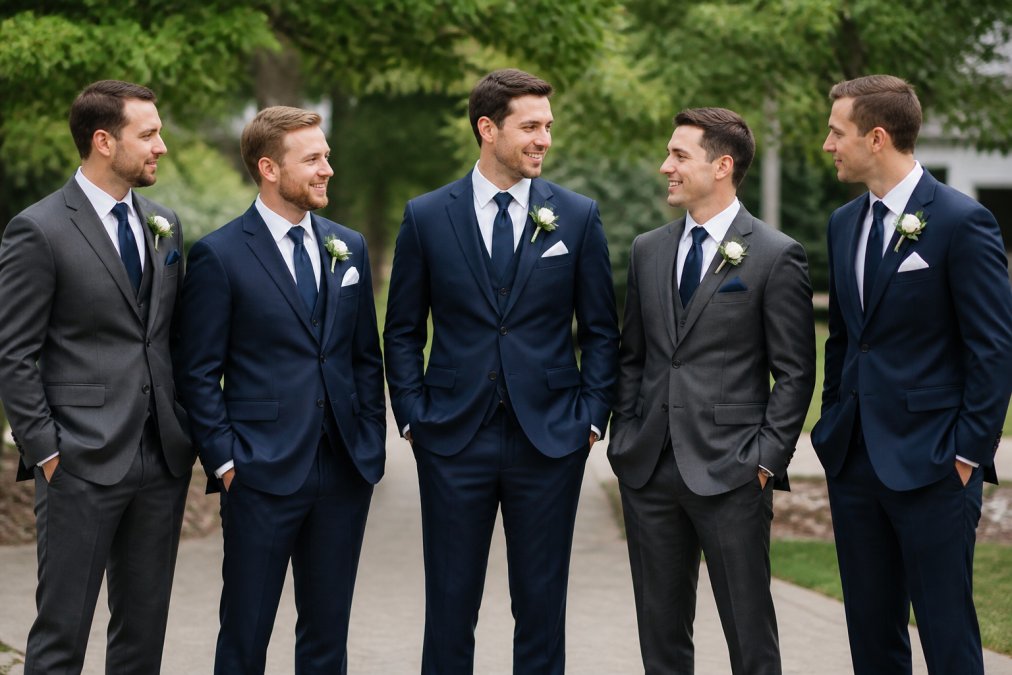
Your groomsmen's formal attire sets the tone for your entire wedding aesthetic. Whether you choose black tuxedos or navy suits, establish a core look, then add personality through accessories.
Selecting Core Suit Colors and Fabrics
Black tuxedos remain the gold standard for formal evening weddings; navy suits work for daytime celebrations; charcoal offers a modern middle ground. Commit to one primary color for all groomsmen, then build variation through accessories.
Premium stretch wool blends, like those in Celebrate Tuxedos' Brooks and Baldwyn styles, provide comfort, durability, and a modern fit. Quality wool blends breathe better than polyester, resist wrinkles, and maintain shape throughout the day.

Ensure all groomsmen wear the same fabric and base color. This consistency is what allows accessory variation to feel intentional rather than chaotic. A navy suit in wool from one vendor and a navy suit in polyester from another will photograph differently and feel noticeably different to wear.
'Brooks' Black Notch Tuxedo Jacket →
Coordinating Ties, Pocket Squares, and Accessories
Mix-and-match ties allow each groomsman to express individual style while maintaining group cohesion. Choose 2-3 coordinating tie patterns: one solid, one subtle stripe, and one with a small geometric print, all complementing your color palette and wedding theme.
Pocket squares add dimension and sophistication. Metallic accents in bronze, gold, or silver work across color schemes. A contrasting pocket square in a complementary shade creates visual interest without disrupting harmony.
Boutonnieres and boutonniere pins matter too. Ensure all groomsmen wear the same style pin and flower combination. Inconsistent florals read as sloppy rather than flexible.
Step 4: Wedding Attire Etiquette for Bridal Parties
Formal wedding attire comes with unspoken rules that elevate your entire celebration. Your bridal party's attire should reflect the formality level and tone you've established.
For black-tie events, tuxedos with satin lapels are standard. For formal daytime weddings, dark suits suffice. Semi-formal celebrations allow cocktail dresses for bridesmaids and suits without tuxedos for groomsmen. Communicate your wedding's formality level clearly.
Shoe choices matter more than many realize.
Step 5: Manage Body Inclusivity and Fit Across Your Party
Your bridal party likely includes people with different body types, heights, and comfort needs. Intentional planning for inclusivity ensures everyone feels confident, and confidence shows in photographs.
Tailoring and Alterations for Diverse Body Types
Invest in professional tailoring for all groomsmen suits. A perfectly fitted suit transforms how someone feels and photographs. Order suits at least 8-10 weeks before the wedding to accommodate tailoring.
Ordering Early and Coordinating Fittings Nationwide
Start ordering 4-6 months before your wedding to allow for alterations and exchanges. Create a shared document with all measurements, sizes, and style preferences for each bridal party member.
Step 6: Budget-Conscious Coordination Strategies
Coordinating a wedding party doesn't require unlimited spending. Strategic choices allow you to achieve a polished, cohesive look while respecting everyone's budget.
Prioritize Investment Pieces and Rentals
For groomsmen, focus investment on the suit jacket, the most visible piece. Celebrate Tuxedos offers premium suits like the Brooks Black Notch Tuxedo ($200) and Baldwyn Navy Notch Lapel Tuxedo ($250) that provide excellent value and can be worn to future formal events.

Reusable Accessories and Shared Rentals
Boutonnieres and corsages are one-time purchases, but other accessories can be reused or shared across multiple events.
Step 7: Communication and Coordination Timeline
Clear communication prevents 90% of bridal party coordination problems. Establish a timeline and stick to it.
Frequently Asked Questions
How do you coordinate bridesmaids and groomsmen attire without being too matchy?
Focus on a cohesive color story rather than identical styles. Use a shared color palette with shade variation—bridesmaids might wear dusty rose in different silhouettes while groomsmen wear charcoal suits with rose-toned accessories. According to 2026 trends, mixing patterns, textures, and statement pieces within a unified color scheme creates visual harmony without rigid uniformity. Accessories like ties, pocket squares, and boutonnieres tie the look together while allowing individual personality.
What are the best color palettes for wedding party coordination?
For 2026, leading color palettes include pastels, warm neutrals, dusty rose, and earthy tones. Rather than choosing one flat shade, select 2-3 complementary colors within your palette to add dimension. For example, pair soft blush with sage green and cream, or layer navy with gold accents and ivory. This approach to color storytelling moves away from single-shade uniformity and creates a more sophisticated, modern wedding aesthetic that photographs beautifully.
How far in advance should you finalize wedding party attire?
Ideally, finalize attire selections 3-4 months before your wedding. This allows time for ordering, alterations, and coordinating fittings across multiple people—especially if groomsmen and bridesmaids are geographically dispersed. For nationwide coordination, order at least 6-8 weeks in advance to ensure availability and allow for tailoring. Communicate color swatches, silhouette preferences, and sizing details early to prevent last-minute delays.
How do you handle different body types when coordinating wedding party outfits?
Prioritize fit over style uniformity. Choose flexible silhouettes—like A-line or wrap dresses for bridesmaids—that flatter various body types. For groomsmen, select suits with tailoring options in multiple cuts (slim fit, classic fit, or modern fit). Professional alterations are essential. Communicate openly with your party about comfort and fit concerns, and budget for alterations as part of your coordination plan.