

All-Day Comfort in Formal Wear: Breathable Linings & Flexible Cuts
Table of Contents
- Why Formal Wear Comfort Matters More Than Ever in 2026
- Breathable Suit Fabrics for Summer Weddings and Warm Climates
- The Benefits of 4-Way Stretch Dress Shirts and Trousers
- How to Choose a Comfortable Tuxedo for Long Events
- Lining Construction: What Separates Breathable Formal Wear from Stiff Alternatives
- Flexible Cuts and Ergonomic Fit: Mobility Without Sacrificing Silhouette
- Sustainable Comfort Technology and Care for Performance Fabrics
- Conclusion: Investing in Comfort That Lasts All Day
- Frequently Asked Questions
Last Updated: September 23, 2026
Why Formal Wear Comfort Matters More Than Ever in 2026
The global formal wear market is projected to reach $13,375.6 million in 2026, and the reason isn't weddings alone. It's that buyers now expect formal wear comfort to match what they get from everyday clothing, according to Market Reports World formal wear market analysis. At Celebrate Tuxedos, we hear the same request from grooms and groomsmen constantly: make it look sharp, but make it wearable for eight hours straight.
That shift has real weight behind it. The global apparel market is projected to grow to $1,804.08 billion in 2026, and natural material attributes like breathability and comfort are named as primary growth drivers, per Fortune Business Insights apparel market report. Formal wear is no longer exempt from that expectation.
Here's what most guides get wrong: they treat comfort as a fabric softness problem. It isn't. Formal wear comfort comes from three things working together: breathable linings, flexible cuts, and construction that lets the garment move with you instead of against you.
Below, we break down exactly how to evaluate all three before you buy or rent.
Breathable Suit Fabrics for Summer Weddings and Warm Climates
The best fabric for a summer wedding is a lightweight wool blend with natural breathability, not the heaviest wool you can find. Wool regulates temperature better than polyester because its crimped fiber structure traps air pockets that buffer heat, and its outer layer is hydrophobic while its core is hydrophilic, so it pulls moisture vapor off the skin and releases it into the air instead of letting it pool against your body.
Fabric weight is measured in grams per square meter (GSM), and the difference is noticeable. For warm-weather formal wear, look for suiting in the 200-260 GSM range. Anything above roughly 300 GSM is built for cold-weather drape and will trap heat no matter how good the weave is. A lighter wool blend keeps air moving across the body, while a dense synthetic shell traps heat with nowhere for it to go.
Weave matters as much as fiber. An open weave like a plain or hopsack weave lets more air pass through than a tightly packed twill, even when both are the same weight. That's why two jackets at 240 GSM can feel completely different in direct sun.
Tan and lighter shades help here too. Light colors reflect more solar radiation than dark ones, which is a measurable difference when you're standing in a ceremony line for 30 minutes. The 'Driftwood' Tan Notch Lapel Jacket is built in a trim fit with a light shade that stays cooler in the sun, and the neutral tone works with almost any accessory color. For a warmer-weather wedding party, that combination of light color and breathable wool does more for comfort than any cooling spray.

One more lever most buyers never pull: the lining. A half-lined or unlined jacket in the back and shoulders lets heat escape through the shell itself. A fully lined jacket in a summer fabric is still a fully lined jacket, the outer fabric can only do so much if the inside is sealed. When you're comparing two jackets at the same GSM, the one with less lining coverage will run cooler.
The Benefits of 4-Way Stretch Dress Shirts and Trousers
Four-way stretch means the fabric flexes in both directions, not just across the body. That matters because a jacket that only stretches side to side still fights you when you reach forward, raise a glass, or hug a relative.
The benefits of 4-way stretch dress shirts and trousers come down to mobility without bagginess. Stretch fibers like elastane let the fabric return to shape after movement, so the garment keeps its tailored silhouette instead of sagging at the knees or elbows by hour three.
Feature |
Rigid Fabric |
4-Way Stretch Blend |
|---|---|---|
Movement range |
Limited |
Full mobility |
Shape retention |
Sags with wear |
Recovers after stretch |
Comfort in heat |
Traps heat |
Moves with body |
Fit appearance |
Baggy or tight |
Tailored and clean |
For anyone who has worn a stiff rental jacket through a full reception, the difference is immediate.
How to Choose a Comfortable Tuxedo for Long Events
The most comfortable tuxedo for a long event is one with a breathable lining, a trim but not tight cut, and side vents that let heat escape. Prioritize those three over lapel style or button count, because you'll feel the difference by the second hour.

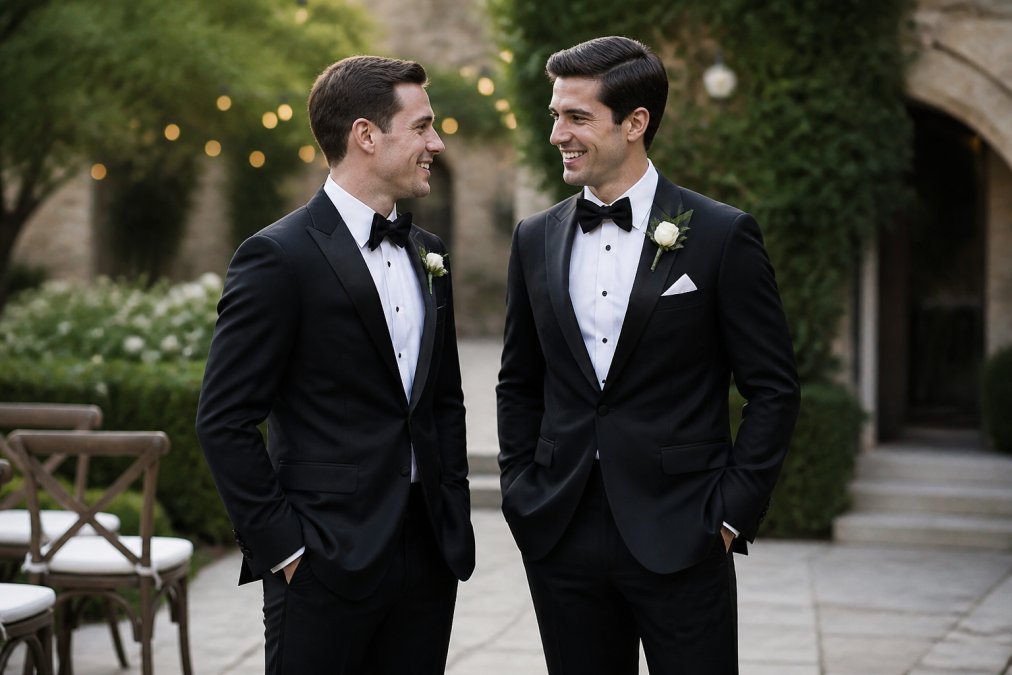
Start with the lining. A breathable lining like Bemberg manages moisture and resists static, which is why it's used in travel suiting designed for all-day wear, as documented in Van Heusen product documentation. Polyester linings provide structure but can trap heat, which is the trade-off most buyers never hear about.
'Brooks' Black Notch Tuxedo Jacket →
Then check the cut. A trim fit with side vents gives you a tailored silhouette without restricting your arms when you dance or reach across a table.
Lining Construction: What Separates Breathable Formal Wear from Stiff Alternatives
Lining construction is the single most overlooked factor in formal wear comfort. A lining isn't decoration. It provides structural support along seams and helps the garment hold its shape, according to research from Iowa State University's study on fusible linings.
The problem is that structure and breathability pull against each other. Fusible linings hold shape well but can reduce airflow. Breathable woven linings like Bemberg allow ventilation while still supporting the jacket's structure.
There are three construction approaches you'll encounter, and they behave very differently over an eight-hour event:
- Fully fused: The jacket's front is glued to an interlining with heat-activated adhesive. Cheapest to produce, holds a crisp shape on the hanger, but the glue layer blocks airflow and can bubble or delaminate after repeated dry cleaning.
- Half-canvassed: A floating layer of horsehair or wool canvas is sewn into the chest and lapels, with fusing only in the lower front. This is the middle ground most quality retail jackets use, it breathes better than full fusing and molds to your chest over time.
- Full canvas: The entire front floats on a sewn canvas with no glue. Best breathability and drape, but the highest cost and the slowest to break in.
Lining fiber choice matters just as much as the interlining. Viscose and acetate linings are cheaper and feel similar at first, but they build static faster and tend to pill where they rub against a dress shirt. Polyester linings are the most durable and the least breathable, they're the reason a well-cut jacket can still feel clammy by hour three.
What most reviews miss is that lining choice affects static, too. Synthetic linings build static against a dress shirt, which makes the jacket cling and bunch.
Flexible Cuts and Ergonomic Fit: Mobility Without Sacrificing Silhouette
Flexible cuts solve the old trade-off between looking sharp and moving freely. Ergonomic tailoring is now identified as a key factor for improving mobility and extended wearability in professional attire, per Ryzeal Sourcing industry analysis.
Sustainable Comfort Technology and Care for Performance Fabrics
Sustainable comfort technology and hybrid-ready designs are named among the top wear-to-work trends for 2026, according to Lands' End Business trend report. That's a shift worth noting: buyers now want performance fabrics that also hold up over time.
Conclusion: Investing in Comfort That Lasts All Day
The hardest part of buying formal wear isn't finding a style you like. It's finding one that still feels good at hour eight, when the photos are done and the dancing has started. Most jackets fail that test because of the lining and the cut, not the color.
Frequently Asked Questions
What fabrics are best for breathable formal wear?
Natural fibers like wool, especially tropical-weight wool and wool blends, offer the best breathability for formal wear. Wool regulates temperature, wicks moisture, and resists creasing. Look for suits labeled with breathable linings such as Bemberg, which manages static and airflow better than polyester. Stretch wool blends with elastane or spandex add flexibility without trapping heat, making them ideal for long events where comfort matters.
How do flexible cuts improve the fit of a tuxedo?
Flexible cuts use ergonomic tailoring and four-way stretch fabrics that move with your body instead of restricting it. This means you can sit, stand, dance, and raise your arms without the jacket pulling or the trousers binding. Trim fit styles with side vents and stretch wool blends maintain a sharp silhouette while allowing full mobility. The result is a tuxedo that looks tailored but feels like everyday clothing.
Why is the lining of a suit jacket important for comfort?
The lining sits between you and the jacket fabric, so its material directly affects how you feel. Breathable linings allow heat to escape and reduce moisture buildup, while polyester linings can trap heat and cause discomfort during long wear. A quality lining makes the difference between a jacket you forget you're wearing and one you can't wait to remove.
How does modern tailoring technology enhance suit comfort?
Modern tailoring uses ergonomic patterns and performance textiles to improve how formal wear fits and feels. Four-way stretch fabrics, sewn-in stays in banded collars, and flexible cuts allow full range of motion without compromising the tailored silhouette. Temperature regulation comes from breathable linings and natural fiber blends that manage heat dissipation. These advances mean you get the polished look of traditional tailoring with the wearability of athletic clothing.