

Best Fabrics for Summer Wedding Suits: 2026 Guide
Table of Contents
- Why Fabric Choice Makes or Breaks a Summer Wedding Suit
- Breathable Suit Fabrics for Hot Weather: The Top Contenders
- Fabric Weight, Weave Density, and Thermoregulation Explained
- Unstructured vs Structured Summer Suits: Construction That Beats the Heat
- Moisture-Wicking Blends and Travel-Friendly Summer Fabrics
- How to Style a Summer Wedding Suit for Any Dress Code
- Budget-Friendly vs Investment Fabrics: Longevity and Value
- Conclusion
- Frequently Asked Questions
Last Updated: September 21, 2026
Why Fabric Choice Makes or Breaks a Summer Wedding Suit
The best fabrics for summer wedding suits are natural fibers with an open weave, and linen, tropical wool, and seersucker consistently outperform everything else when temperatures climb. This guide covers which summer wedding suits breathe, how construction affects heat regulation, and how to style each option.
Breathable Suit Fabrics for Hot Weather: The Top Contenders
Breathable suit fabrics for hot weather share three traits: natural fibers, an open weave, and a light fabric weight. Linen leads on airflow, tropical wool wins on structure, and cotton and seersucker split the difference between texture and formality. The table below compares the main contenders.
Fabric |
Breathability |
Wrinkle Resistance |
Formality |
Best For |
|---|---|---|---|---|
Dual Stretch |
Highest |
Low |
Casual to formal |
All wedding atmospheres |
Tropical wool |
High |
High |
Semi-formal to formal |
Long weddings, photos |
Fresco weave |
High |
High |
Semi-formal |
Hot, humid afternoons |
Cotton |
Moderate |
Moderate |
Casual |
Daytime garden events |
Seersucker |
High |
High |
Casual |
Beach and outdoor weddings |
Linen: The King of Breathability
Linen is the most breathable suiting fabric you can buy. Flax fibers are hollow, which lets air move through the cloth and pulls heat away from the body, and the loose weave adds ventilation. The trade-off is crease recovery: linen wrinkles fast. For an outdoor ceremony in full sun, that's a fair exchange. A linen blend softens the wrinkles while keeping most of the airflow.
Tropical Wool and Fresco Weave: Structured Comfort
Tropical wool is a lightweight, high-twist wool woven with an open structure, and it's the best choice when you want breathability without sacrificing drape. Fresco weave takes the same idea further with a porous, basket-like construction that moves air and resists creasing. Both hold a crease far better than linen, which matters for a groom photographed for eight hours.
Cotton and Seersucker: Versatile and Textured
Cotton sits in the middle on breathability but offers the widest range of finishes, from smooth chambray to crisp poplin. Seersucker is cotton woven with varying tension so the fabric puckers, and those puckers lift the cloth off your skin, improving airflow and wrinkle resistance. Seersucker reads casual, so it suits beach and garden weddings better than black-tie events.
Fabric Weight, Weave Density, and Thermoregulation Explained
Thermoregulation in a suit comes down to two numbers: fabric weight in GSM (grams per square meter) and weave density. Summer suiting typically falls between 200 and 260 GSM, and anything above 280 GSM belongs in a different season. Weave density is the less obvious factor. An open weave lets moisture vapor escape and cooler air enter, while a tight weave blocks both, which is why two 240 GSM fabrics can perform nothing alike.
Unstructured vs Structured Summer Suits: Construction That Beats the Heat
Fabric is only half the battle. The other half is what's sewn inside the jacket, and most summer suiting guides skip it entirely. A jacket's construction determines how much heat gets trapped against your torso, and two jackets cut from the same 230 GSM tropical wool can feel completely different depending on how they're built.
The Three Construction Tiers
- Fully canvassed: Floating canvas stitched (not glued) throughout the chest. Best drape and longevity, but the most insulation. Rarely right for a summer wedding unless the fabric is very light.
- Half-canvassed: Floating canvas in the chest and lapels only; the lower body is fused or lightly structured. The sweet spot for most summer weddings, you keep shape through the chest for photos but shed the heavy interlining below the waist where heat builds up.
- Unstructured (unlined or soft-tailored): No canvas, minimal interlining, sometimes no shoulder padding. Feels almost like a shirt. Breathes best, but can look limp in formal photos and won't hold a crisp silhouette through a long ceremony.
Lining Is the Biggest Single Lever
If you change one thing about construction for a summer wedding, change the lining. A fully lined jacket covers your entire back and torso in a layer of cupro, bemberg, or polyester that blocks airflow. A quarter-lined jacket (also called a butterfly or half-lined jacket) covers only the shoulders and upper back, leaving the lower back open to the air.
A few practical rules:
- Ask the tailor or brand whether the jacket is quarter-lined, half-lined, or fully lined. "Unlined" usually means quarter-lined in practice.
- Bemberg (cupro) lining breathes better than polyester. If you have a choice, take the cupro.
- Skip the shoulder pads if you can. Padding traps heat at the neck and shoulders, where you feel it first.
- Side vents (two vertical slits at the back) let heat escape when you sit or put your hands in your pockets. Center vents are fine; ventless jackets run hotter.
Matching Construction to Formality
A common pattern among wedding parties: unstructured for beach and garden ceremonies, half-canvassed for anything with a formal or semi-formal dress code. If the groom is in half-canvassed tropical wool and the groomsmen are in unstructured linen, the photos will show it, the silhouettes won't match. Pick one construction tier for the whole party and vary the fabric instead.
Moisture-Wicking Blends and Travel-Friendly Summer Fabrics
Moisture-wicking blends are the quiet upgrade most summer suit shoppers miss. Wool naturally manages moisture by absorbing vapor and releasing it, and modern stretch wool blends add elastane for movement without killing breathability. If you're traveling to the wedding, look for high-twist wool or a wool-linen blend: they resist creasing in a garment bag and survive a flight far better than pure linen.
'Driftwood' Tan Notch Lapel Jacket →
How to Style a Summer Wedding Suit for Any Dress Code
Styling a summer wedding suit comes down to three levers: color, accessories, and formality match. Light colors reflect heat and photograph well in bright sun, so tan, ivory, and pale gray are safe defaults. For a formal dress code, keep the fabric refined (tropical wool or a wool blend) and the accessories tonal. For casual outdoor weddings, seersucker or linen with lighter accessories works beautifully.
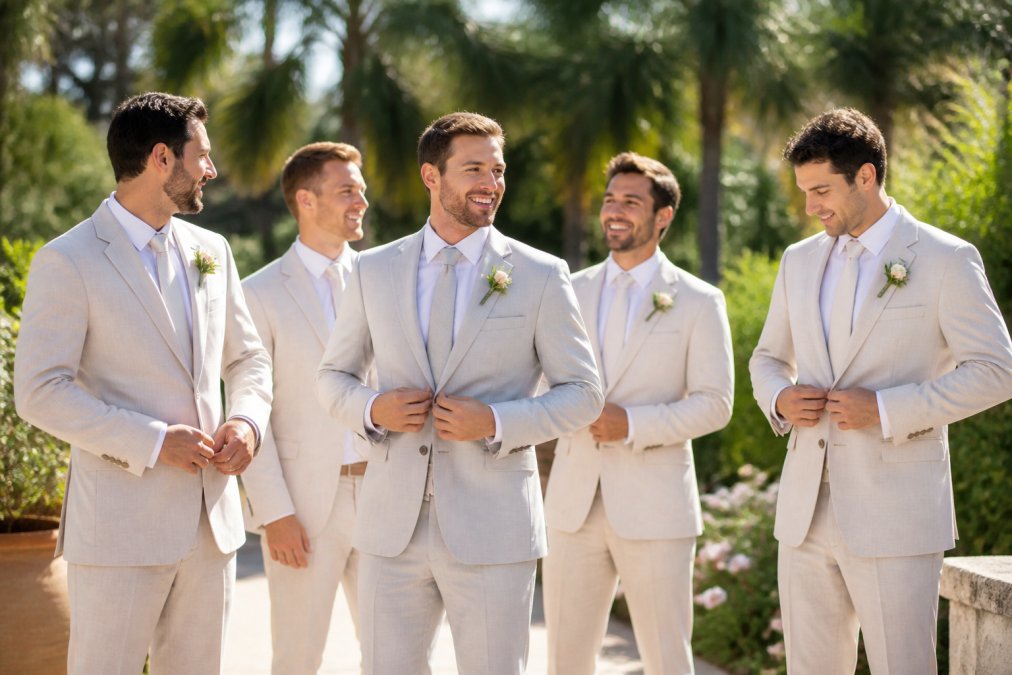
- Match fabric weight across the party so everyone looks consistent in photos
- Skip dark accessories with light suits; they pull focus from the couple
- Choose a tie in the same material family as the jacket for a cohesive look
- For black-tie optional, a light suit with a matching vest reads more formal than a two-piece
- Give groomsmen a fabric cheat sheet so out-of-state orders stay consistent
Budget-Friendly vs Investment Fabrics: Longevity and Value
Most summer suiting guides list fabrics and stop. They don't tell you what actually wears out, how many seasons each fabric survives, or how to think about cost per wear. That's the gap this section fills.
What Actually Fails on a Summer Suit
Summer suits fail in predictable ways, and the fabric determines which failure you'll hit first:
- Cotton and seersucker: The fibers abrade at high-friction points, inner thighs, elbows, seat, and the color fades with sun exposure. A cotton suit worn weekly through one summer often shows visible wear by the second season.
- Linen: Pure linen doesn't wear out quickly, but it creases permanently at stress points over time, and the fiber can weaken at the seams if dry-cleaned too often. Linen blends (linen-wool, linen-cotton) hold up noticeably better.
- Tropical wool and fresco weave: High-twist wool resists pilling and holds its shape through repeated wear. This is the fabric that survives the most seasons, which is why it's the standard recommendation for a suit you'll wear beyond one wedding.
- Wool blends with elastane: The stretch helps movement, but elastane degrades with heat and repeated dry cleaning. A 2-3% elastane blend is fine; higher stretch content loses recovery faster.
Cost Per Wear, Not Sticker Price
A useful way to compare: divide the purchase price by the number of times you'll realistically wear the suit. A cheaper cotton or seersucker suit worn to one wedding and then left in the closet has a very high cost per wear. A tropical wool suit worn to three or four summer events a year for several seasons usually wins on cost per wear even though it costs more upfront.
The Middle Path: Wool Blends
A wool blend, typically wool with linen, silk, or a small amount of synthetic, balances cost, breathability, and durability. It costs less than pure high-twist wool, breathes better than cotton, and resists creasing better than pure linen. For a wedding party on a mixed budget, a wool blend keeps everyone looking consistent without forcing anyone into a suit they'll never wear again.
Spend on Construction, Not the Label
A well-made half-canvassed jacket in a quality wool blend will outlast a cheaper fully fused jacket by several seasons of summer events, regardless of the label. When comparing two suits at similar prices, look at construction first: half-canvas over fused, quarter-lined over fully lined, side vents over ventless. Those three choices affect both comfort and how long the suit holds its shape.
Conclusion
Choosing among the best fabrics for summer wedding suits is really a decision about priorities: maximum airflow, wrinkle resistance, or budget. Linen wins on breathability, tropical wool and fresco weave win on structure, and cotton and seersucker win on versatility and price. Whichever you choose, construction matters as much as fiber, and a quarter-lined, side-vented jacket will keep you cooler than any fabric upgrade alone.
Frequently Asked Questions
What is a good lightweight summer suit for a wedding?
A lightweight suit in the 200-260 GSM range works well for summer weddings. Linen, tropical wool, and seersucker are top choices because they allow air to circulate and manage moisture. For a polished look, consider a tan or ivory trim-fit suit in a breathable wool blend, which balances structure with comfort for long ceremonies and receptions.
What type of suit is best for hot, humid weather?
For hot, humid conditions, prioritize air permeability and moisture-wicking. Linen and seersucker excel at letting heat escape, while tropical wool and fresco weaves offer structure without trapping humidity. Unstructured or quarter-lined jackets reduce bulk and improve ventilation, keeping you cooler during outdoor ceremonies and photos.
Is linen or cotton better for a summer wedding suit?
Linen wins on breathability and natural texture, making it ideal for beach or garden weddings. Cotton, especially in a seersucker weave, offers better wrinkle resistance and a crisper look for indoor or semi-formal settings. Both work well; choose linen for relaxed elegance and cotton seersucker for a polished, low-maintenance option.
How do I style a summer wedding suit without overheating?
Opt for light colors like tan, ivory, or pastel, and choose a trim fit with side vents for airflow. Skip the heavy lining and consider a half-canvas or unstructured jacket. Pair with a breathable shirt, a matching vest for layering, and loafers. A matching tie in the same fabric keeps the look cohesive without adding weight.